Terminology
Within the Project
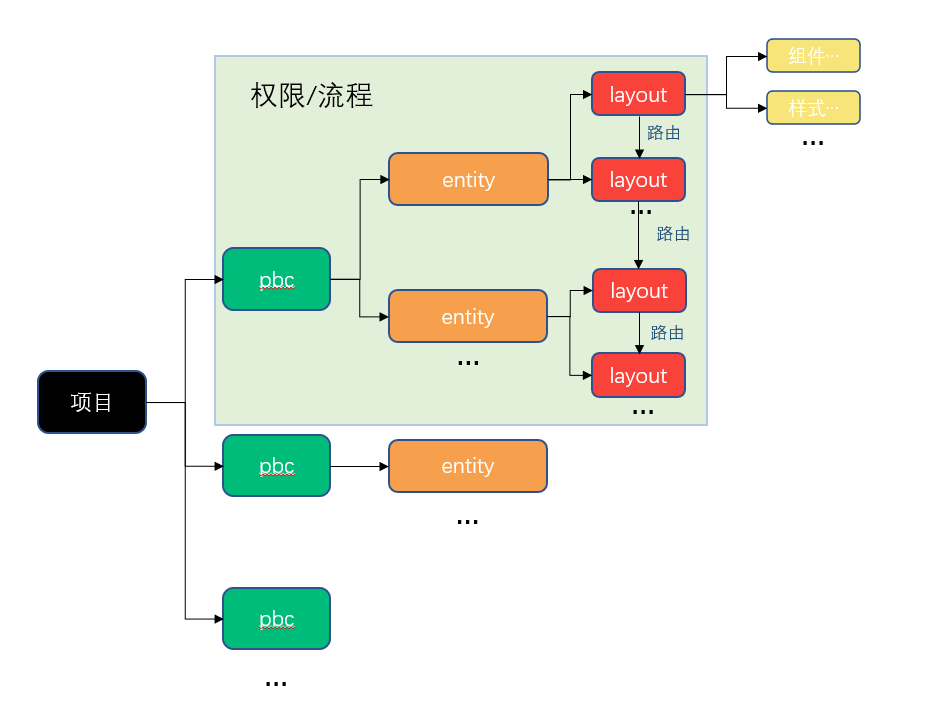
project: A project, also known as a project, can contain multiple PBMs. A project is unique across the platform.
pbc: A component, PBM contains multiple entities and multiple flows. It can be independently published and is unique under a project. For example: In the platform, Marketing -> AI Platform Management Model -> Model Management is a PBM.
Design Pages
entity: A data model, similar to a set of data structures. For example: If a form contains fields for name and age, then name and age constitute an entity.
layout: The presentation form of an entity in different scenarios. For example: When creating a new entry, placing age above name can be defined as one layout, while placing age below name in the edit view can be another layout.
schema: Each page generated by the form designer is a schema. For example: A "form" or a "page" under "Content Configuration" in a PBM is a schema.
route: In a project, when displaying a specific page, the address in the browser's address bar corresponds to a route.
token: Unique identifier under a project.
Editing Logic
flow: A flow corresponds to business logic. A flow can have multiple nodes, and each node can have multiple operations. For example: The approval process for a contract can generally be divided into three nodes: "Create Contract," "Approve Contract," and "Sign Contract."
flowInstance: When a flow is initiated on the platform, a flowInstance is generated. This flowInstance records the current state of the flow and the operation records of the flow.
formEntity: A formEntity is generated when a form flow is initiated.
formEntityData: The data corresponding to a formEntity. Each formEntityData has a formEntityId, which corresponds to the ID of the formEntity.
sdk: An SDK can perform a specific business operation.
Consensus on Concepts
- Changes made on the platform can be synchronized to the test run environment, and refreshing will display the latest page.
- An entity can have multiple layouts. In different scenarios, we are simply presenting different layouts of the same entity.
- The same form shares one entity.
- Each page under a route is independent and does not share data.
- The display of different pages is driven by routes.
- There are two ways to start a flow:
- Submission of a form (a button in the form with a type of submit)
- Triggered by a trigger within the flow.
- A table is a collection of multiple formEntityData, where each row corresponds to one formEntityData.
- Currently, the login page uses an email address as the account. When creating a new user, there must be an email field with the ID of "email."